
How to Calculate Property Valuation in India
In This Article
In the Indian property market, two plots of the same size can still have very different values. One may offer better road access, clear legal documents, and stronger future demand. The other may appear cheaper but come with hidden limitations. This is why buyers should look beyond property size alone.
Property valuation helps you understand what a property is truly worth. It also helps you compare the actual market value with the government benchmark, known in Maharashtra as the circle rate (रेडी रेकनर दर). In growing areas, property prices in Karjat can vary widely from one village to another.
In this guide, we will explain how to calculate property valuation in India in a simple and practical way for land buyers and investors.
What Is Property Valuation?
Property valuation is the process of estimating the current worth of a property based on market conditions and the specific characteristics of the property.
It is not just a number taken from a listing website. A proper valuation looks at what similar properties are selling for and then adjusts for legal status, location, and future growth potential.
It also reflects the realities of the local market. A plot that appears inexpensive may not be a good deal if it has title issues or poor access.
A proper valuation takes into account:
- Location
- Land area
- Legal status
- Road access
- Government circle rate
- Market demand
- Future growth potential
In simple terms, property valuation answers one key question: What is this property reasonably worth in today’s market?
Why Property Valuation Is Important

Many buyers focus only on the asking price. But the asking price does not always reflect actual value.
Some sellers set property prices based on what they expect to receive rather than actual market trends. Others keep extra room for negotiation. Which means the quoted price may not always be the final selling value. Knowing the true value helps you:
1. Avoid Overpaying
Many buyers make the mistake of trusting only the seller’s asking price. But in reality, the quoted price is not always equal to the actual market value. Property valuation helps you understand whether the land or property is reasonably priced compared to nearby sales and local demand.
It also becomes easier to compare different options before making a final decision. This can save buyers from paying more than what the property is truly worth in the current market.
2. Negotiate Better
When you already understand the market value of a property, negotiations become much easier and more practical. Instead of depending only on emotions or pressure from sellers, buyers can discuss prices using proper market information.
Sellers also take buyers more seriously when they know current rates and recent transactions nearby. Good valuation knowledge gives confidence during discussions and helps buyers avoid making rushed decisions that may later feel expensive or unfair.
3. Estimate Registration Costs
Property valuation is also important because registration charges and stamp duty are usually linked to government circle rates. Many buyers only focus on the land price and forget about additional expenses involved in the purchase process.
When you understand the property’s valuation properly, it becomes easier to calculate the total budget required. This helps buyers avoid last-minute financial pressure and gives a more realistic idea of the overall cost before completing the transaction.
4. Plan Investments
People who invest in land or property usually want good future returns. Property valuation helps buyers compare different areas and understand which locations may have stronger growth potential in the coming years. It also helps identify places where infrastructure, tourism, or connectivity may improve property prices over time.
Instead of buying property based only on advertisements or low prices, buyers can make decisions using actual market conditions and long-term investment possibilities.
5. Secure Financing
Banks and financial institutions normally check property valuation before approving loans. The final valuation helps them decide how much loan amount can be offered to the buyer.
Properties with clear documents, better locations, and stronger market demand usually have a smoother financing process. Proper valuation also helps buyers understand whether the property supports the required loan amount. This makes the entire loan process more transparent and reduces confusion during approval and documentation.
Property Valuation Methods Indian Buyers Should Know
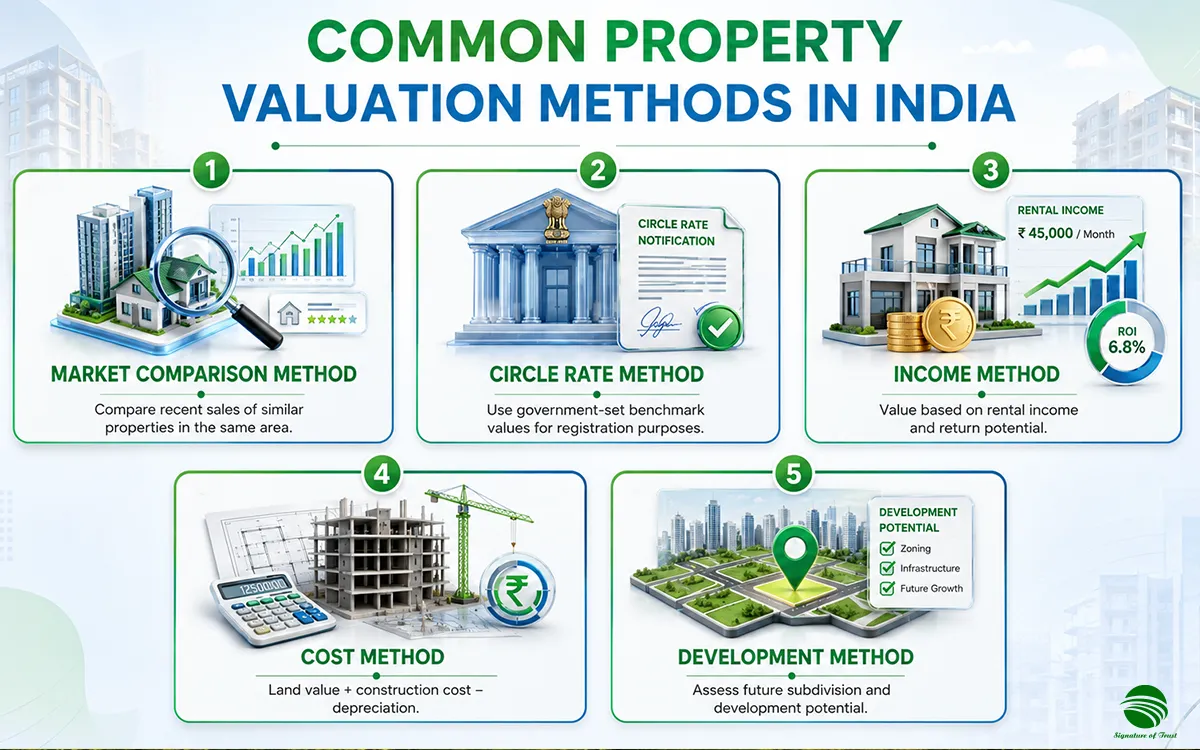
Different types of properties are valued in different ways. A flat in a city and a land parcel in Karjat are assessed using different considerations.
Understanding the common property valuation methods India uses can help you evaluate prices more accurately.
1. Market Comparison Method
This is the most widely used approach. The value is estimated by comparing recent transactions of similar properties in the same area. The closer the comparison, the more reliable the estimate.
If nearby plots in Karjat are selling for ₹10 lakh per guntha, that becomes a useful benchmark. Buyers should compare properties with similar road access, approvals, and location advantages for a more accurate estimate.
2. Circle Rate Method
The government sets a minimum value for each area. This is called:
- Circle Rate
- Ready Reckoner Rate (रेडी रेकनर दर)
- Guidance Value
Registration cannot usually be done below this benchmark. However, actual market prices are often higher. This method helps buyers estimate stamp duty and registration expenses before purchasing a property. Circle rates also help authorities maintain a minimum benchmark for property transactions in each area.
3. Income Method
Used for gated community projects, where value depends on security, amenities, and overall maintenance of the project. Projects with proper roads, electricity, water supply, gardens, and security systems often attract premium prices from buyers.
Properties that generate regular rental income are often valued higher because they provide steady returns to investors. Buyers also consider occupancy levels and future rental demand while evaluating income-based property value.
4. Cost Method
Land value plus construction cost minus depreciation. This method is often used for independent buildings. It helps estimate how much it would cost to rebuild the same property today while adjusting for the building’s age and condition.
Older buildings may have lower value because repair and maintenance costs increase over time. Construction quality, materials used, and structural condition also play an important role in this valuation method.
5. Development Method
Used for large land parcels with subdivision or development potential. This method is commonly applied to land that may be converted into residential layouts, villas, or commercial projects in the future.
Factors such as zoning rules, infrastructure growth, and approval possibilities can significantly influence the final valuation. Investors often use this method to estimate how much the land value may increase after future development and approvals.
Market Value of Property in India
The market value of land or property in India is the amount that both parties agree on during a fair transaction. This value reflects real market demand rather than only government rates.
This is the most practical measure of value because it reflects actual demand in the market.
The market value may be higher than the official circle rate (रेडी रेकनर दर).
For example:
- Circle rate: ₹8 lakh per guntha
- Actual market rate: ₹12 lakh per guntha
In this case, the practical market value is closer to ₹12 lakh per guntha.
This is why serious buyers compare both official and real-world pricing before making a decision.
How to Calculate Property Value
One of the simplest ways to estimate the value of a plot is by using the following formula:
Property Value = Land Area × Market Rate
Let's take an example of a 5-guntha plot in Karjat.
- Plot Size: 5 guntha
- Market Rate: ₹10 lakh per guntha
Calculation:
Property Value = 5 × ₹10 lakh = ₹50 lakh
So, the estimated market value of the plot is ₹50 lakh.
This calculation provides a basic estimate and is a useful starting point when evaluating land. However, the final value of a property may be higher or lower depending on several factors. These can include the exact location of the plot, road connectivity, development in the surrounding area, title clarity, NA approvals, access to utilities, and future growth potential.
For this reason, buyers should use the market-rate calculation as an initial guide and then consider other property-specific factors before making an investment decision.
How to Calculate Property Value as Per Circle Rate
The circle rate (Ready Reckoner Rate) is the minimum value set by the government for a property. It is mainly used to calculate stamp duty and registration charges. Even if a property is sold for a lower amount, authorities may use the circle rate as the minimum value for registration purposes.
For example:
- Circle Rate: ₹7 lakh per guntha
- Land Area: 5 guntha
Calculation:
Circle Rate Value = 5 × ₹7 lakh = ₹35 lakh
So, the official value of the property for registration purposes is ₹35 lakh.
In many cases, the actual market value may be higher than the circle rate value. When this happens, stamp duty and registration charges are generally calculated on the higher value rather than the circle rate.
How to Find the Circle Rate of a Property
In Maharashtra, circle rates are published as (रेडी रेकनर दर). You can check them on the official Maharashtra IGR portal website.
The portal is publicly available and is the most reliable source for government benchmark values.
Steps to Check the Circle Rate
- Open the portal.
- Select district.
- Choose the taluka and village.
- Select the property category.
- View the applicable rate.
These rates are updated periodically, so it is always wise to check the latest figures before making a decision.
How to Check Circle Rate of Property in Karjat?
To check the circle rate(रेडी रेकनर दर) for land in Karjat:
- Select District: Raigad
- Select Taluka: Karjat
- Choose the relevant village
Each village has its own ready reckoner rate, and values can vary depending on zoning and property use.
Land near schools, markets, and tourist attractions generally has better market value. Circle rates may also change depending on whether the property is agricultural, residential, or commercially approved.
Why Circle Rate & Market Rate Matter
Many buyers make the mistake of looking at only one number.
But both rates serve different purposes, and understanding the difference can prevent costly decisions.
Circle Rate(रेडी रेकनर दर)
- Government benchmark
- Used for stamp duty and registration
- Minimum acceptable valuation
Market Rate
- Real-world selling price
- Reflects demand and local trends
- Indicates investment value
Knowing both the market rate and circle rate helps buyers judge the property's actual value more clearly. It also helps in planning the overall property budget properly.
Property Valuation in Karjat
Property valuation in Karjat has become increasingly relevant as the region attracts investors from Mumbai, Navi Mumbai, and Pune.
Karjat is no longer seen only as a weekend destination. It is steadily emerging as a serious land investment market with growing residential and tourism interest.
Karjat offers:
- Better affordability than major urban markets
- Scenic surroundings
- Growing demand for second homes
- Improving infrastructure
- Long-term development potential
Because of this, valuation in Karjat depends heavily on micro-location and land classification.
A plot close to the railway station or major road may command a significantly higher price than land farther away.Buyers can find property in Karjat across all categories NA plots, agricultural land, farmhouses, and villas on our listings page.
How to Check Property Value in Karjat
If you want to know how to check property value in Karjat, begin with local market research.
Many online listings show prices based on expectations rather than completed sales. Local market knowledge and physical visits often give more practical and reliable information.
1. Compare Similar Properties
Look at recent sales of similar plots or homes in the same village or nearby project area. Comparing actual transaction prices helps you understand the realistic market value. It also allows buyers to identify whether a property's asking price is in line with local market conditions. Comparing properties with similar size, approvals, and access can lead to a more accurate valuation.
2. Check Ready Reckoner Rates
Use the official IGR portal to check the government-approved Ready Reckoner rates for the area. These rates give you a basic benchmark value used for stamp duty and property registration. Reviewing the Ready Reckoner rate also helps buyers estimate registration costs more accurately. While market prices may differ, the government rate provides an important reference point during the evaluation process.
3. Evaluate Plot Features
The value of a plot depends on more than just its size. Buyers should carefully assess factors such as road access, legal approvals, plot shape, topography, and the availability of basic utilities like water and electricity. A plot with better accessibility and clear approvals is often easier to develop, finance, and resell, making it more valuable in the long run.
4. Speak with Local Experts
Local real estate consultants understand village-wise pricing trends better than online listings alone. They can often provide insights into recent transactions, upcoming developments, and factors that may affect property values in specific locations.
Their local knowledge can help buyers make more informed decisions and avoid relying solely on advertised prices.
NA Plot Valuation in Karjat
An NA plot in Karjat is generally more valuable than agricultural land because it is legally approved for residential or commercial development. This reduces legal uncertainty and makes the property easier to finance, develop, and resell.
NA plot valuation in Karjat depends on:
- Project location
- Approval status
- Internal roads
- Electricity and water access
- Amenities
- View and surroundings
A fully approved NA plot , a gated project often attracts a premium because buyers value convenience and lower risk.
How to Find Market Value of Agricultural Land
Agricultural land is valued differently from NA plots. Its value depends not only on present use but also on the possibility of future development. Land located near growing urban areas may have stronger prices.
When assessing how to find the market value of agricultural land, consider:
- Soil that supports healthy crop production generally increases the value of agricultural land.
- Land with reliable water sources, such as wells, borewells, or canals, is usually worth more.
- Agricultural land with proper road access is easier to use, transport from, and resell.
- Land with strong potential for future NA conversion often commands a higher market price.
- Properties located closer to towns, highways, and railway stations typically attract stronger demand.
- New roads, housing projects, and other nearby development can significantly increase land value over time.
Agricultural land close to expanding towns often commands higher prices due to future conversion possibilities.
Price Per Guntha in Karjat
In Karjat, land is commonly priced per guntha.
One guntha equals 1,089 square feet, and this unit is widely used in local land transactions.
Using the price per guntha in Karjat makes it easier to compare plots quickly and understand whether a property is competitively priced.
For example:
- Plot A: ₹8 lakh per guntha
- Plot B: ₹11 lakh per guntha
The higher-priced plot may justify the premium if it has NA approval, better access, and stronger appreciation prospects.
Always compare price per guntha alongside legal and location factors.
Common Factors That Influence Property Value

Beyond size and location, several details can affect valuation.
These factors may not be obvious at first glance, but they often influence buyer interest and resale value significantly.
1. Title Clarity
Land with clear ownership documents usually has better value because buyers feel more secure. Properties with legal issues may become difficult to sell later.
When all the documents are clear and properly verified, buyers feel more confident about investing their money. Properties with missing papers, ownership confusion, or legal disputes often take more time to sell and may also lose value in the market.
2. Road Frontage
Plots with proper road access are easier to use and develop in the future. Good frontage can also increase resale demand.
Land connected to a proper road is more convenient for daily use, construction work, and future development. Buyers usually prefer plots with better access because transportation becomes easier and the property feels more practical for long-term use.
3. Topography
Flat land is easier and less costly to develop compared to uneven land. This is why flat plots often have better market value.
Uneven or rocky land may require extra work before construction can begin, which can increase overall costs. Flat land is generally easier for building homes, farming, landscaping, and other activities, which is why many buyers prefer it.
4. Infrastructure Growth
New roads, railway projects, and nearby development can increase property prices over time. Areas with improved infrastructure usually attract more buyers.
When a new highway, railway station, or major project is announced nearby, land prices often start increasing gradually. People usually invest more confidently in areas where future development and better connectivity are expected.
5. Surroundings
Greenery, open views, and a peaceful environment can improve property value. Buyers often prefer locations with better surroundings and nearby facilities.
A calm and clean environment can make a property more attractive for both living and investment purposes. Plots located near schools, markets, hospitals, or tourist spots often see better demand because they offer more convenience to buyers.
Common Mistakes Buyers Make During Property Valuation
Even experienced investors can misjudge valuation. Most mistakes happen when buyers focus only on price and overlook legal or practical details.
Avoid these mistakes:
- Online listings often show asking prices, which may be very different from actual transaction values.
- Ignoring circle rates (रेडी रेकनर दर) can lead to incorrect assumptions about registration costs and minimum government valuation.
- Title issues, such as ownership disputes or missing documents, can significantly reduce a property's real value.
- Comparing properties with different approvals, locations, or access can give misleading conclusions.
- Skipping a site visit may cause buyers to miss important details such as terrain, surroundings, and road connectivity.
- Underestimating future infrastructure can cause buyers to overlook areas with strong appreciation potential.
A little due diligence can prevent expensive mistakes.
Why Accurate Property Valuation Matters

Property valuation is not about finding one perfect number. It is about understanding what gives a property its real value. When you compare circle rates (रेडी रेकनर दर) with market prices and check legal documents, location, and future development, you can make better decisions.
In Karjat, land prices vary from one village to another. Road access, title clarity, and nearby infrastructure can significantly affect long-term returns. A property that seems affordable may offer less growth potential than one in a stronger location.
At Universal Properties Karjat, we help buyers understand actual market values, compare land options, and choose properties with good investment potential. If you are planning to buy property in Karjat, understanding valuation before visiting any listing will save you time and money Whether you are considering an NA plot, agricultural land, or a long-term investment, our team provides honest advice based on local experience.
FAQs (Frequently Asked Questions)
Property valuation means finding the current market worth of a property. It helps buyers understand whether the price of land, a house, or a plot is fair. The value depends on location, documents, demand, and nearby property rates.
The market value is the actual selling price in the local market. The रेडी रेकनर दर is the minimum government value used for registration and stamp duty. In many areas, the market value is higher than the रेडी रेकनर दर. This is very common in growing locations.
You can check property value in Karjat by comparing nearby sales and checking the local रेडी रेकनर दर. A site visit also helps. It gives you a better idea about road access, surroundings, and development nearby. Local property experts can also help you understand village-wise pricing.
NA plots are approved for residential or commercial use. Because of this, they are easier to develop and resell. Banks also prefer financing approved plots. This is one reason why NA plots usually have a higher value than agricultural land.
Good road access, clear title documents, nearby infrastructure, and future development can increase land value in Karjat. Railway connectivity and tourism growth also affect prices. Plots near highways or popular locations often attract stronger demand.